

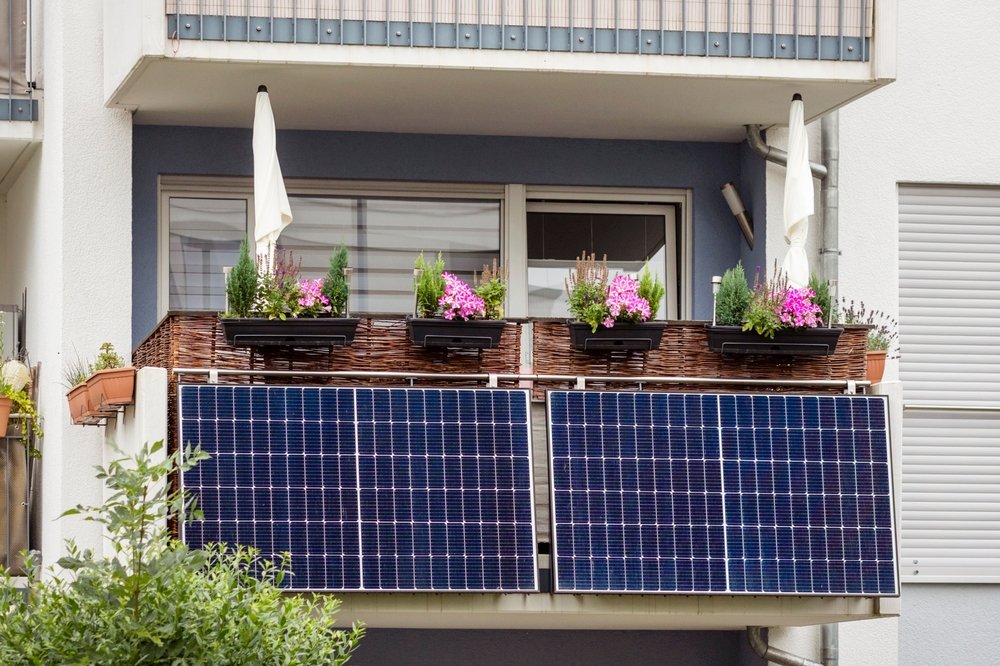
Balcony solar is becoming an increasingly practical option for UK households that want to generate some of their own electricity without installing a large rooftop solar system.
For people living in flats, apartments or homes with limited roof space, a balcony solar setup can provide a relatively accessible way to make use of available sunlight.
However, there is one common challenge: solar electricity is not always generated when you need it most.
A balcony solar system may generate useful electricity during the middle of the day, while household demand often increases in the evening when people return home, prepare dinner, switch on lights and use appliances.
This is where battery storage can help.
The Problem with Using Solar Power as It Is Generated
Solar panels only generate electricity when there is sufficient sunlight.
During the daytime, there may be periods when nobody is at home or household electricity consumption is relatively low. In these situations, some of the electricity generated by the panels may not be used immediately.
The opposite can happen in the evening.
Once the sun goes down, solar generation stops, but electricity demand can increase.
Without storage, a household has limited ability to shift the electricity generated at lunchtime into the evening.
A battery changes this equation by allowing surplus electricity to be stored and used later.
Instead of thinking about solar generation and electricity consumption as two separate moments, battery storage helps connect them.
Store Daytime Solar for Evening Use
The basic idea behind solar battery storage is simple.
During periods of solar generation, electricity can be used directly by household appliances. If more electricity is available than the home needs at that moment, the surplus can potentially be stored in a battery.
Later in the day, when solar generation decreases, stored energy can be used to support household demand.
For a balcony solar user, this could mean making better use of electricity generated during the daytime rather than allowing available generation to go unused.
The exact amount of energy that can be stored and used will depend on the solar system, battery capacity, household consumption and installation configuration.
Why Battery Capacity Matters
A battery needs enough capacity to store meaningful amounts of surplus solar energy.
The Conow Lyra 2500 Pro features a 2560Wh LFP battery, providing a 2.56kWh-class storage capacity.
For households combining smaller-scale solar generation with battery storage, this provides a way to store energy generated earlier in the day and make it available later.
LFP, or lithium iron phosphate, is also widely used in energy storage applications because of its durability and thermal characteristics.
Of course, the right battery size depends on individual electricity consumption. A household with relatively low evening demand may need less storage than a family using several appliances after work.
More Solar Inputs Can Mean More Flexibility
Balcony solar installations are not always positioned in a single, ideal direction.
Depending on the property, panels may face different directions or experience different levels of sunlight throughout the day.
The Lyra 2500 Pro features four MPPTs and supports up to 2400W of PV input.
Multiple MPPTs can provide greater flexibility when managing solar inputs from different PV sources, although the appropriate configuration depends on the panels, electrical requirements and installation design.
This can be particularly relevant for households looking to combine balcony solar with additional PV capacity as their energy needs develop.
From Balcony Solar to Home Energy Storage
One of the advantages of a battery-based approach is that the system does not have to be viewed purely as a balcony solar accessory.
It can form part of a broader home energy strategy.
A household might begin with a relatively small solar setup and later look at how battery storage can support more of its electricity consumption.
Instead of using solar power only at the moment it is generated, stored energy can become part of the household’s evening electricity supply.
This is particularly useful during the UK autumn and winter, when daylight hours are shorter and household electricity demand often shifts towards the evening.
Smart Energy Management Can Improve Flexibility
There is another challenge with battery storage: deciding when the battery should charge and discharge.
Solar generation changes throughout the day, while household electricity demand also varies.
Electricity tariffs can add another layer of complexity.
Some UK energy tariffs vary depending on the time of day, creating potential opportunities to use stored electricity when grid electricity is more expensive.
The Conow Lyra 2500 Pro includes AI HEMS and supports more than 1,000 dynamic tariffs.
A smart home energy management system can help coordinate solar generation, battery storage, household consumption and tariff conditions, reducing the need for homeowners to manually monitor every change.
The potential financial benefit will depend on the household’s tariff, energy consumption, solar generation and battery usage, so savings should not be assumed to be the same for every home.
Is Balcony Solar Storage Worth Considering?
For UK households with limited roof space, balcony solar can be an interesting way to start generating renewable electricity.
But generating electricity is only half of the equation.
The more important question is how much of that electricity can actually be used.
A battery can help address the mismatch between when solar electricity is generated and when household electricity is needed.
With its 2560Wh LFP battery, four MPPTs, 2400W PV input and 1500W bi-directional inverter, the Conow Lyra 2500 Pro is designed to support a flexible solar-plus-storage setup.
For homeowners and apartment residents exploring balcony solar, combining generation with storage can turn daytime surplus into useful evening energy.
Rather than simply asking how much electricity your balcony panels can generate, it may be more useful to ask how much of that electricity your household can actually use.
Solar generates the energy. Storage helps you choose when to use it.


