

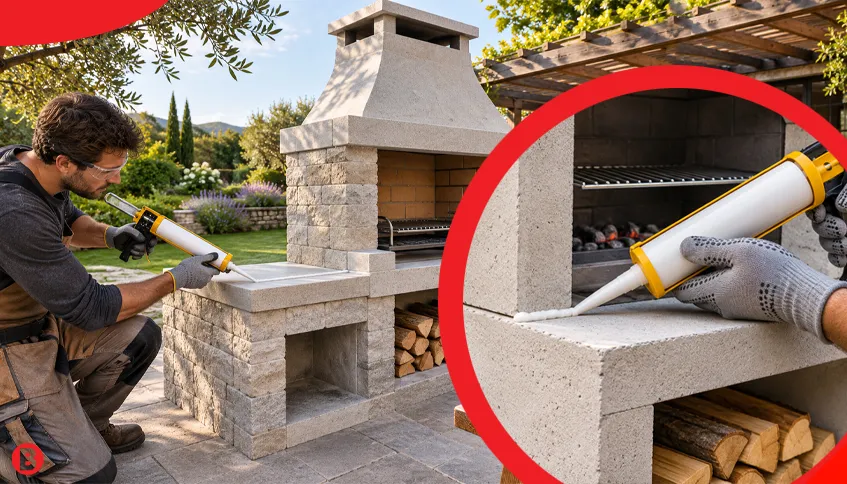
Building a masonry barbecue requires suitable materials, a stable foundation and a reliable adhesive. Barbeglue is a specialist adhesive designed to connect prefabricated barbecue components. Its flexible bonding properties, weather resistance and convenient application make it useful for outdoor construction and home improvement projects.
Unlike ordinary household adhesives, Barbeglue is formulated for more demanding applications. It works with various construction materials, including concrete, brick, stone and metal. However, understanding its application method, curing time and temperature limitations is essential for achieving durable results.
What Is Barbeglue?
Barbeglue is a specialist adhesive-sealant associated with Sarom Fuoco, an Italian manufacturer of masonry barbecues and outdoor cooking equipment. Technically known as Isocoll ECO 6056, it uses a silyl-terminated polymer (STP) formulation that creates a strong yet flexible bond between compatible surfaces.
Its primary purpose is to connect designated components during masonry barbecue assembly. However, its versatility extends to certain construction and industrial applications. Despite its barbecue-related name, Barbeglue is not a cooking ingredient, glaze or edible adhesive.
How Does Barbeglue Work?
Barbeglue uses a moisture-curing mechanism that activates when the adhesive comes into contact with atmospheric moisture. During curing, the material gradually transforms from a workable paste into an elastic solid, forming a secure connection between compatible materials.
This flexibility helps accommodate minor expansion and contraction caused by temperature changes. Additionally, its single-component formulation eliminates the need for mixing, making preparation and application relatively straightforward.
Key Features of Barbeglue
Barbeglue combines several practical characteristics that make it suitable for outdoor bonding applications. According to the manufacturer’s technical documentation, its main specifications include:
| Feature | Specification |
|---|---|
| Chemical base | STP polymer |
| Appearance | White or grey paste |
| Density | 1.42 g/cm³ |
| Tensile strength | 2.10 N/mm² |
| Shore A hardness | 45 |
| Elongation at break | Approximately 400% |
| Application temperature | 5°C to 50°C |
| Temperature resistance | −40°C to 100°C |
| UV resistance | Yes |
| Paintability | Yes, after curing |
| Shelf life | 24 months |
Actual bonding performance depends on surface preparation, environmental conditions and correct application.
Common Uses of Barbeglue
The primary application of Barbeglue is assembling prefabricated masonry barbecues. These structures typically contain separate concrete sections that require secure connections during installation. The adhesive helps hold designated components together while maintaining flexibility.
It can also support compatible outdoor kitchen installations, including attached worktops and side tables. Beyond barbecue assembly, its technical documentation identifies applications involving roofing, construction joints, industrial panels and transportation equipment, subject to material compatibility and operating conditions.
Benefits of Using Barbeglue
One of the main advantages of Barbeglue is its combination of adhesion and elasticity. Outdoor structures experience temperature fluctuations and changing weather conditions, making flexible bonding particularly beneficial.
Other practical benefits include:
- Resistance to outdoor weather conditions and UV exposure.
- Convenient application without mixing.
- Compatibility with various construction materials.
- Ability to accommodate limited material movement.
- Paintable finish after curing.
- Solvent-free and isocyanate-free formulation.
These characteristics make Barbeglue a practical choice for compatible outdoor assembly projects where durability and ease of application are important.
Compatible Materials
Although Barbeglue is primarily associated with masonry barbecues, its polymer formulation supports several materials used in construction and home improvement.
Common compatible materials include concrete, brick, natural stone, marble, wood, aluminium, stainless steel, glass, porcelain and plasterboard.
Surface preparation remains essential for achieving effective adhesion. Painted materials, protective coatings and certain surface finishes may require compatibility testing before application. Always check the manufacturer’s recommendations before bonding unfamiliar materials.
How to Apply Barbeglue
Correct application helps improve bonding performance and prevents unnecessary installation problems. Before starting, prepare a cartridge gun, cleaning materials, protective gloves and a spirit level.
Follow these basic application steps:
- Prepare the foundation: Ensure the barbecue rests on a stable and level surface.
- Clean the surfaces: Remove dust, grease, loose particles and other contaminants.
- Prepare the cartridge: Attach the nozzle and insert the cartridge into the application gun.
- Apply the adhesive: Distribute it across the designated bonding areas.
- Position the components: Assemble the sections carefully and check their alignment.
- Allow curing: Leave the structure undisturbed for the recommended drying period.
Always follow the assembly instructions for your barbecue model, as certain removable or refractory components may need to remain unbonded.
Drying Time and Heat Resistance
Barbeglue has an approximate surface drying time of 30 minutes and a curing rate of 3 mm per 24 hours under specified conditions. Temperature, humidity and adhesive thickness can influence the overall curing process.
Sarom’s barbecue assembly instructions recommend waiting at least 48 hours before using the completed structure. Additional drying time may be necessary depending on environmental conditions.
Barbeglue withstands temperatures between −40°C and 100°C. However, it is not fireproof and should not come into direct contact with flames or burning charcoal.
Barbeglue vs Traditional Adhesives
Different adhesives offer different bonding characteristics. Choosing the correct product depends on the construction materials, joint location and expected operating temperature.
| Feature | Barbeglue | Ordinary Silicone | Refractory Mortar |
|---|---|---|---|
| Flexibility | High | Generally high | Generally low |
| Heat resistance | Up to 100°C | Varies | Grade-dependent |
| Paintability | Yes | Often limited | Product-dependent |
| Outdoor suitability | Yes | Product-dependent | Product-dependent |
| Sarom BBQ assembly | Approved joints | Not recommended | Approved joints |
Sarom recommends suitable refractory mortar as an alternative for specified barbecue assembly applications. Ordinary silicone glue and non-refractory mortar should not be used as substitutes where the manufacturer’s instructions prohibit them.
Safety and Limitations
Barbeglue is a construction adhesive rather than a food-contact product. Avoid applying it directly to cooking grates or surfaces that come into contact with food unless explicitly approved by the manufacturer.
Wear suitable protective gloves during application and store unopened cartridges in a dry environment between 5°C and 25°C. Under recommended storage conditions, the product has a shelf life of approximately 24 months.
It should not replace professional structural repairs involving unstable foundations, severely damaged masonry or cracked fireboxes.
Where to Buy Barbeglue
Barbeglue is available through selected home improvement retailers, barbecue equipment suppliers and online stores. European retailers such as Eurobrico and Bricomarché list it among their barbecue assembly accessories.
Cartridge sizes and prices vary by supplier. Before purchasing, check the product specifications, packaging condition and compatibility with your particular barbecue model.
Final Thoughts
Barbeglue provides a practical bonding solution for masonry barbecues and compatible outdoor construction projects. Its flexible formulation, weather resistance and straightforward application offer several advantages over ordinary adhesives.
However, reliable results depend on proper surface preparation, correct application and sufficient curing time. Following the manufacturer’s instructions and respecting the product’s temperature limitations can help achieve a secure, durable barbecue installation.
FAQs
Is Barbeglue waterproof?
Barbeglue offers good weather and moisture resistance, but it is not recommended for permanent underwater applications.
Can Barbeglue withstand high temperatures?
Yes, it withstands temperatures up to 100°C. However, it is unsuitable for direct exposure to flames or burning charcoal.
How long does Barbeglue take to dry?
The surface becomes tack-free in approximately 30 minutes, but deeper curing takes longer depending on adhesive thickness and environmental conditions.
Can Barbeglue repair cracked concrete?
It may help bond compatible concrete surfaces, but structural cracks and damaged fireboxes require specialized repair materials.
What is a good alternative to Barbeglue?
Manufacturer-approved refractory mortar is a suitable alternative for designated masonry barbecue assembly applications.


